
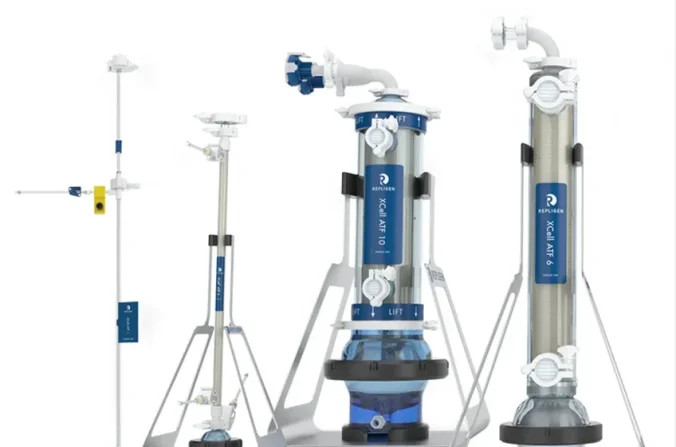
Continuous manufacturing has been a mature approach for bulk chemicals for many years, yet its adoption in biologics has moved more slowly. A recent Repligen publication highlights that only a small share of approved biologic products are currently made using perfusion or continuous downstream processing, and that many of these are not fully continuous but operated in a piecewise fashion. For EMA Engineering’s clients in the Turkish and regional pharma and biotech sector, this transition is worth understanding closely.
Why the shift is happening
The main barriers to continuous biologics manufacturing have been the complexity of automation and the challenge of validation. Batch processes remain familiar and well understood by regulators and production teams alike. However, the pressures on modern biomanufacturing — cost reduction, facility footprint, flexibility and time to market — are steadily pushing developers toward intensified and continuous strategies.
What continuous processing offers
Continuous and intensified operations can deliver meaningful advantages for manufacturers:
- Smaller footprint: higher productivity per unit volume reduces the size of bioreactors and downstream equipment.
- Improved consistency: steady-state operation can support more uniform product quality.
- Lower capital and operating costs: intensified processes can reduce the scale of expensive equipment and consumables.
- Greater flexibility: single-use technologies and perfusion enable faster changeover between products.
Relevance for the regional market
As pharmaceutical and biotech companies in Turkey and neighboring markets expand into biosimilars and novel biologics, the choice of process architecture directly affects competitiveness. Technologies such as perfusion cell culture, alternating tangential flow filtration and single-pass tangential flow filtration form the practical building blocks of process intensification.
EMA Engineering supports clients in evaluating where continuous or intensified steps fit within their existing facilities, balancing regulatory expectations with operational goals. The move toward continuous bioprocessing is not an all-or-nothing decision; many manufacturers begin by intensifying individual unit operations before pursuing fully integrated systems.
As the field continues to evolve, staying informed about these developments helps producers make sound long-term investment decisions.
Explore EMA Engineering’s Repligen product range.
For product details, technical support or a quote, contact EMA Engineering via our contact page or call +90 212 798 2047.
Source: Repligen.