
Plasmid DNA (pDNA) may rarely appear in the final vial of a therapy, but it plays a fundamental role in determining the quality and performance of the entire manufacturing process.
As a small, circular DNA molecule, pDNA carries the genetic instructions used as a template for mRNA synthesis. It is also an essential starting material for viral vector production, including lentivirus and adeno-associated virus (AAV), as well as DNA vaccines, gene editing and cell and gene therapy applications.
For pharmaceutical and biotechnology companies developing these advanced therapies, pDNA is a critical upstream component that directly influences process efficiency, product quality and manufacturing consistency.
Why Does pDNA Quality Matter?
Although pDNA is consumed at the early stages of manufacturing, its quality has a significant impact on subsequent downstream processes.
Key attributes such as plasmid yield, purity, molecular form, impurity profile and batch-to-batch consistency can influence the efficiency and reliability of the entire production workflow.
A robust and well-controlled pDNA manufacturing process provides a consistent starting material, helping manufacturers improve downstream performance, optimise recovery and maintain product quality.
Key Challenges in pDNA Manufacturing
As demand for advanced therapies continues to grow, manufacturers face several technical and operational challenges:
-
Increasing global demand and the need for higher production capacit
-
Process scalability and cost-effectiveness
-
Plasmid sensitivity to shear stress during processing
-
Low productivity and purification yields
-
Separation of open circular and other plasmid forms to achieve the required purity
-
Limited in-line process monitoring across both cell-based and cell-free production platforms
-
Maintaining consistent product quality from development to GMP manufacturing
Technologies Enabling More Efficient pDNA Manufacturing
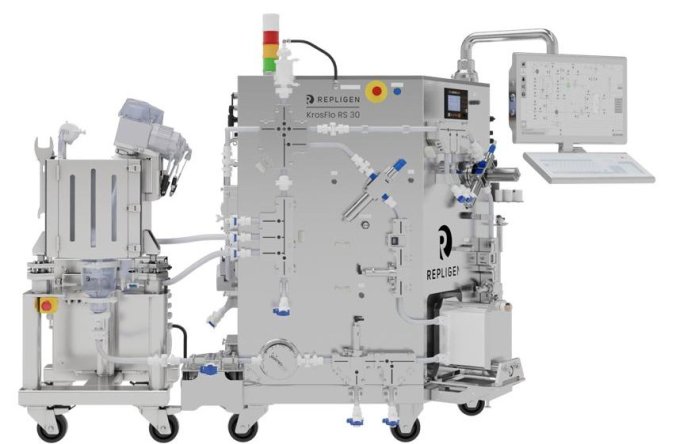
Repligen offers a range of technologies designed to address critical bottlenecks in plasmid DNA production and purification.
These solutions support process intensification, improved recovery and greater control throughout the manufacturing workflow.
Key technologies include:
-
Perfusion-Based Process Intensification: Enhances microbial productivity and supports increased plasmid production capacity.
-
Tangential Flow Filtration (TFF): Provides an alternative to conventional centrifugation for cell harvest and supports efficient clarification and concentration steps.
-
Low-Shear Chromatography and TFF Systems: Help protect plasmid integrity while reducing product hold-up volume and improving recovery.
-
Pre-Packed Chromatography Columns: Support process consistency, reproducibility and simplified implementation.
-
Single-Use Flow Paths: Enable closed processing configurations and support contamination control strategies.
-
In-Line Process Analytics: Provide real-time process monitoring and help manufacturers maintain control over critical quality attributes.
Together, these technologies help streamline pDNA production, improve process efficiency and support scalable manufacturing operations.
Supporting the Future of Advanced Therapies
For manufacturers developing mRNA therapeutics, viral vectors and cell and gene therapies, establishing a reliable and scalable pDNA production process is a strategic priority.
EMA Engineering supports pharmaceutical and biotechnology manufacturers in Turkey and the surrounding region by providing access to advanced process technologies, equipment and consumables from leading technology partners, including Repligen.
From process development to GMP-scale manufacturing, we work closely with our customers to identify solutions that meet their specific process requirements, improve operational efficiency and support the transition towards reliable, compliant and scalable production.

EMA Engineering – Enabling Advanced Biopharmaceutical Manufacturing.
Explore EMA Engineering’s Repligen product range.
For product details, technical support or a quote, contact EMA Engineering via our contact page or call +90 212 798 2047.
Source: Repligen.