
Gene therapy pipelines based on viral vectors — most commonly adeno-associated virus (AAV) and lentiviral vectors — continue to face significant manufacturing challenges. As advanced therapy medicinal products gain increasing regulatory momentum in Türkiye and the surrounding region, manufacturers and process development teams need scalable strategies that enable the transition from laboratory-scale development to GMP manufacturing without carrying forward unnecessary process inefficiencies.
Repligen’s viral vector portfolio addresses several of these challenges through technologies designed to improve process productivity, intensify upstream operations, and simplify downstream processing. EMA Engineering supports pharmaceutical and biotechnology companies in Türkiye and the region in evaluating and implementing these technologies as part of their viral vector manufacturing strategies.
Key Manufacturing Challenges in Viral Vector Production
Viral vector manufacturing can be particularly challenging to scale. Common limitations include low viral vector yield, limited viable cell density (VCD) in the production bioreactor during transfection, multiple harvest requirements, low downstream recovery, and complex workflows based on triple-plasmid transfection.
These challenges can be further compounded by the clarification of cell lysates and inefficient downstream purification, particularly for organizations developing viral vector manufacturing capabilities or establishing new production platforms.
As processes move toward larger scales and GMP manufacturing, addressing these limitations becomes increasingly important for controlling facility footprint, equipment requirements, manufacturing costs, and overall process complexity.
Process Intensification with TFDF
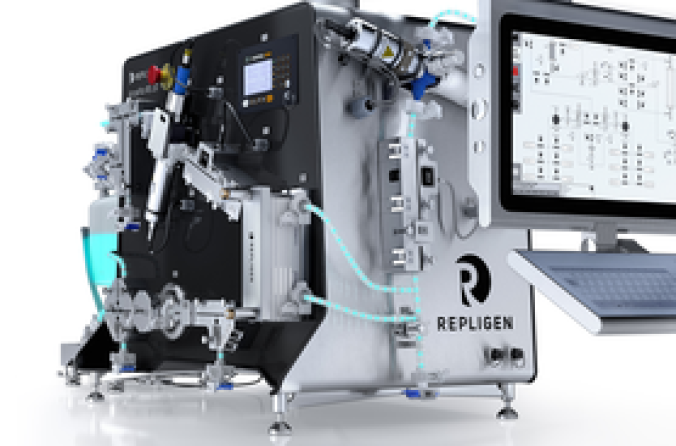
Repligen’s approach incorporates KrosFlo TFDF technology for process intensification in viral vector manufacturing.
Applied to both transient and stable producer cell lines, TFDF-based process intensification enables higher viable cell densities and can help mitigate the cell density effect that may limit transfection efficiency at higher cell concentrations.
According to Repligen, TFDF-based intensification can significantly increase viral vector productivity while reducing the required production scale compared with conventional batch processes. The approach can also contribute to a more streamlined clarification step following harvest.
For manufacturers, these improvements can translate into a smaller equipment and facility footprint, increased process productivity, and a more efficient transition from harvest to downstream purification.
An Integrated Upstream and Downstream Approach
Process intensification should not be viewed as an isolated upstream solution. Efficient viral vector manufacturing requires coordinated optimization across the overall process, from seed train and production through clarification and purification.
Repligen’s viral vector workflow brings together technologies covering multiple stages of the manufacturing process, including:
-
Seed train intensification to increase viable cell density in the N-1 bioreactor
-
Integrated perfusion and continuous clarification
-
Gene therapy-specific affinity resins and high-throughput resin screening and optimization
-
Low-shear, low-hold-up-volume downstream equipment
-
Single-use fluid management solutions supporting closed and streamlined processing
By connecting these technologies within an integrated process strategy, manufacturers can work toward higher productivity, reduced process complexity, and greater scalability.
Why Process Intensification Matters in Viral Vector Manufacturing
As investment in cell and gene therapy continues to grow in Türkiye and the surrounding region, efficiency, scalability, and process control are becoming increasingly important considerations in viral vector manufacturing.
Higher viral vector yields and reduced production scale can have a direct impact on capital investment, facility and equipment requirements, manufacturing capacity, and time to clinic.
Repligen’s process intensification approach enables upstream and downstream operations to be considered as part of an integrated manufacturing strategy, supporting the development of more efficient and scalable viral vector production processes.
EMA Engineering, together with Repligen’s application expertise and technical solutions, supports pharmaceutical and biotechnology companies across Türkiye and the region in evaluating viral vector manufacturing processes, identifying appropriate technologies and equipment, and developing solutions aligned with specific process requirements.
Reducing complexity in viral vector manufacturing can help improve operational efficiency, mitigate process risks, and support a more controlled transition to GMP manufacturing.
Explore EMA Engineering’s Repligen product range.
For product details, technical support or a quote, contact EMA Engineering via our contact page or call +90 212 798 2047.
Source: Repligen.